Have you ever felt your car trembling while driving, or the steering wheel drawing towards a particular side? It indicates that your car needs wheel balancing and alignment. Although most of us tend to disregard these issues, they are critical in ensuring a smooth ride, higher mileage, and safety on the road.
In some cases, the road condition may change from smooth expressways to bumpy inner town roads within seconds, and maintaining your car is not only a choice but a necessity.
Knowing what they are, why they are important, and how to detect their existence can enable maintaining the car in a fine state and avoiding expensive maintenance in the future.
Car tyre alignment or wheel alignment entails correctly positioning the wheels’ angles, like lying parallel to each other, and perpendicular to the earth. This operation ensures the tyres have the right contact with the road, which is crucial for optimum handling and wear of tyres. Wheel alignment is an excellent solution for handling your vehicle, as the steering is much easier, and the workload of the suspension system decreases.
Types of Wheel Alignment
Wheel or tyre positioning involves the position of the tyres so that the angle is right and straight to the ground. There are three major types of it: Toe alignment, which is concerned with the angling of the tyres so that they become parallel to the ground as viewed by the eyes.
1. Camber alignment: Adjusts the vertical angle of the tyre to provide even wear and tear.
2. Caster alignment: Calculates the tilt of the steering axis in the side view to assist the steering and to steer the car straight.
What is Wheel Balancing?
Wheel balancing entails the redistribution of the weight in the wheels. This process helps ensure that the tyres move easily at very high speeds, and no vibration or uneven wear of the tyres. In case of an unbalanced wheel, the tyre wobbles and provides an uncomfortable ride, which also ends up causing damage to the suspension system.
Wheel balancing is divided into two categories: static balancing and dynamic balancing. The issue of vertical imbalance is addressed using the concept of static balancing, and the problem of vertical and lateral imbalances is corrected using the concept of dynamic balancing. Balancing of the wheels is vital to keeping a smooth ride as well as prolonging the life of your tyres.
Types of Wheel Balancing
Wheel balancing evenly distributes the weight of the tyre and wheel assembly by adding small weights. It is of two types:
1. Dynamic balancing: After the technician determines how heavy the tyre and wheel combination is, they attach small weights to obtain a balance.
2. Match force balancing: The technician seeks the lowest and the highest points of the tyre and the wheel and alters the tyre. Although dynamic balancing ensures that your car does not vibrate or hop when driven, road force balancing is important to ensure that your car runs smoothly.
Balancing the wheels regularly makes the vehicle more efficient in fuel consumption, safeguards the suspension, increases the tyre’s lifetime and increases safety.
The Importance of Wheel Alignment and Balancing
The failure to check wheel balancing and alignment may have several consequences on your car, other than causing tyre wear. Here’s why both are essential:
1. Better Driving Safety When the wheels are properly aligned and balanced, your car will be predictable in how it responds. The abrupt lane altering, braking, or cornering becomes safer and smoother.
2. Extended Tyre Life
Frequent tyre rotation and balancing help avoid uneven wear, which prolongs the life of your tyres and helps you save money.
3. Better Fuel Efficiency
Mismatched wheels create resistance, and your engine starts straining. Proper positioning can enhance mileage and save on the cost of fuel.
4. Comfort and Ride Quality
No vibrations caused by balanced wheels will lead to a smoother and quiet ride.
5. Less Suspension Wear
Correctly installed wheels cause less stress on the suspension parts and can effectively save on expensive repairs. In other words, it is important to maintain your wheels regularly to improve their performance, efficiency, and safety, and to remain in the mood for driving.
Significant Dissimilarities between Car Wheel Alignment and Balancing
The following six are the most important differences you need to know between car wheel balancing and alignment.
1. Purpose of the Service
Wheel Alignment is concerned with making the angles of the wheels (that is, camber, caster, and toe) parallel to each other and perpendicular to the ground. This guarantees good contact of the tyres with the road and handling.
Wheel balancing, on the other is concerned with the equal distribution of the wheel’s weight and tyre around the axle. It removes vibration and provides smooth rotation of tyres.
Simply put, alignment helps to set the wheels straight, whereas balancing helps to set the weight distribution straight.
2. Symptoms and Signs
The symptoms that report misalignment are very distinct compared to the wheel imbalance. Some of the symptoms of misalignment include the vehicle pulling to a side, a tyre wearing unequally or unusually fast, and a crooked steering wheel when driving straight. Imbalance symptoms manifest through vibrations in the steering wheel, seat or floorboard, particularly at higher speeds and uneven wear patterns of the tyres.
When your car seems to be sliding over, it must be an alignment problem; shaking or vibrating is a balancing problem.
3. Components Adjusted
Wheel Alignment is the adjustment of suspension and steering parts that affect the wheels’ location and direction. Special alignment machines adjust the technicians’ camber, caster, and toe specifications.
Suspension parts are not adjusted in Wheel Balancing. Rather, it emphasizes the tyre and wheel assembly. Mass is introduced to counterbalance any heavy areas that a balancing machine may detect.
4. Tools and Equipment Used
Wheel Alignment involves a computerized alignment system, laser sensors, and aligning racks to measure and correct the wheel angles accurately.
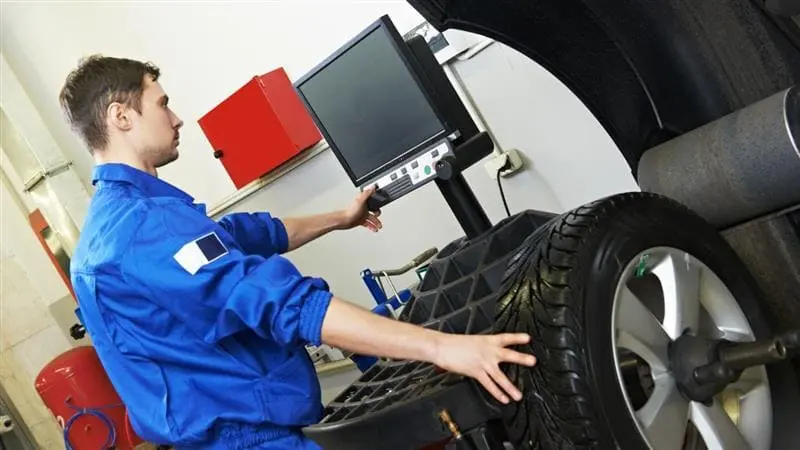
A wheel balancing machine is used to conduct Wheel Balancing, spin the wheel to determine the uneven distribution of weights, and then apply the little counterweights to fix the imbalance.
Even though car mechanics in Perth use precision technology, their tools have various diagnostic and corrective purposes.
5. Frequency of Service
Regular maintenance of cars involves alignment and balancing, though they differ according to their recommended frequency.
The check of Wheel Alignment must be conducted approximately every 10,000-12,000 kilometers or annually at least. It is also required to hit potholes, curbs, or when working on the feels that are off.
Though alignment concerns long-term suspension geometry, balancing is usually performed more regularly because of tyre wear and use.
Wheel Alignment and Balancing Cost
The prices of car wheel alignment and balancing in Australia differ according to several factors, including vehicle type, location, and the feasibility of service level.
The average cost of wheel alignment of a typical passenger car is between AUD 50 and 150. Vehicles such as SUVs, 4WDs, luxury cars, and larger cars may cost between AUD 150 and 250 because they usually need more modifications or new state-of-the-art features.
Wheel balancing is normally charged individually and is cheaper. The tyre costs more than AUD 15 to 30 per tyre, depending on the size of the tyre and the type of vehicle. For 4WDs or high-performance cars, the price can go up to AUD $25-40 per tyre.
The car workshops in Perth provide packages for alignment and balancing at a reduced price, which is a good alternative in case of regular check-ups.
Note: Prices mentioned here are rough estimates. Call us to confirm the service cost with our mechanics.
Conclusion
Two important but neglected parts of car maintenance are wheel balancing and alignment. Alignment works well in keeping your wheels facing the correct direction, but balancing will ensure that your wheels rotate smoothly and evenly.
They are vital to tyre lifespan, ride comfort, fuel efficiency and safety. If you have observed uneven wear of tires, steering drift, or vibrations, do not ignore them. Go to the professional wheel alignment services in Peth and check. Wheel check-ups and balancing are sure ways to save money and ensure every drive is easier, safer, and more enjoyable.
1. What is the way of needing an alignment or balance?
Answer 1:
If your car drives off to one side or one of the tyres wears unevenly, you likely require an alignment. Balancing is necessary when vibrations are felt in the steering wheel or the seat.
2. Do you need wheel balancing and alignment?
Answer 2:
Yes, balancing and wheel alignment are necessary to maintain your car in an effort to keep it safe. Alignment ensures your tyres are set at the right angles, whereas balancing ensures weight distribution. When combined, both services help make your ride in the car a safer and smoother ride.
3. What is the duration of the wheel balancing and alignment?
Answer 3:
Wheel balancing normally requires 30 minutes and one hour, whereas wheel alignment can require one hour or longer, depending on the alignment required and the equipment involved.